







For years industrial automation has faced a clear dilemma. On one side: traditional PLC systems that are highly reliable, robust and fully compliant with industrial standards, but closed, proprietary and expensive. On the other: hobby boards such as the Raspberry Pi — remarkably flexible, low cost and backed by a vast open-source community, yet unable to survive the harsh conditions of the plant floor (vibration, dust, electromagnetic noise, an operating range of -25 °C to +55 °C).
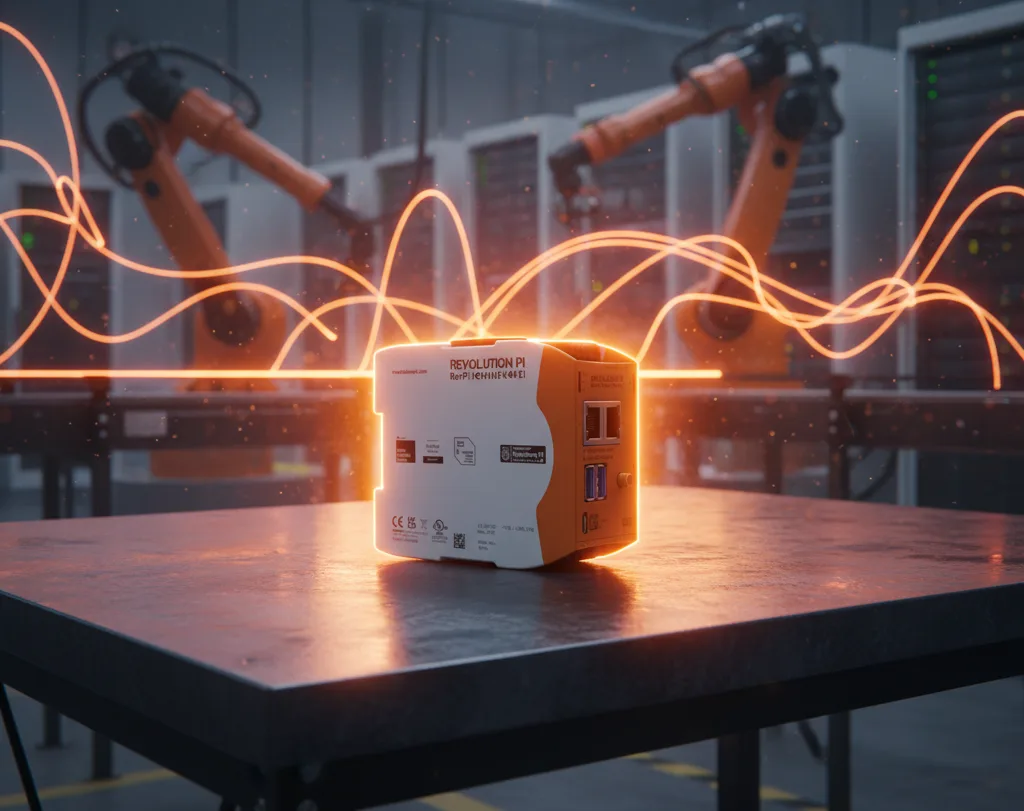
Revolution Pi, developed and manufactured in Germany by KUNBUS, is a genuinely industrial IPC platform based on the Raspberry Pi Compute Module and designed to close that gap. Its guiding philosophy is to bring open-source flexibility together with industrial reliability.
It is far more than a Raspberry Pi on a DIN rail: it is an integrated system designed from the ground up to meet demanding industrial standards such as EN 61131-2 (the PLC standard) and EMC compliance.
The Official Solution Partner in Türkiye: ICC Dijital
The full Revolution Pi range, along with software support and integration services, is provided by ICC Dijital Endüstriyel Teknolojiler Ltd. Şti., the sole official representative in Türkiye. ICC Dijital is not only a distributor but a value-added system integrator specialising in industrial automation, edge computing, industrial artificial intelligence and machine learning.
Part 1: The Underlying Philosophy and a Distinctive Architecture
Two architectural features set Revolution Pi apart from a standard IPC or a Raspberry Pi: the PiBridge backbone and the central process image.
1.1. The PiBridge Architecture: Determinism Guaranteed in Hardware
The cornerstone of the platform's industrial suitability is the PiBridge backbone — not a simple connector between modules but a deliberately designed dual-bus architecture.
In industrial control, determinism — operations happening in predictable, consistent time slots — is vital. If high-speed I/O data collides on the same bus with high-bandwidth network traffic (a file transfer, say, or PROFINET traffic), a critical I/O update can be delayed, causing a process fault or a dangerous condition.
PiBridge solves this as follows:
- The fast lane (RS485 data channel): A fast, dedicated RS485 channel serves all critical, deterministic I/O modules (DI, DO, AIO and so on).
- The data lane (Ethernet channels): Two independent 100 Mbps Ethernet channels serve the high-bandwidth gateway modules (PROFINET, EtherCAT and so on).
Because of this separation, the millisecond control loops are never interrupted, even while the device is exchanging heavy traffic with upper-level IT systems.
1.2. PiCtory and the Central Process Image
The software cleverness of Revolution Pi lies in a central memory area called the process image. PiCtory is the browser-based graphical tool used to configure it.
In PiCtory you drag and drop modules and give them symbolic names — "module 1 on the left is a DIO, called 'Motor_Control'". The piControl driver running in the background reads that configuration and builds the corresponding process image in memory.
The benefit is hardware abstraction. A Python script, a CODESYS program or a C++ application no longer deals with physical pins but with meaningful names in the process image, such as "Motor_Control.O_1". So if the hardware topology changes later — if the module order changes, for instance — there is no need to touch the software; updating the configuration in PiCtory is enough.

Part 2: The Hardware Portfolio — Base Modules
The Revolution Pi portfolio is split into three main families for different needs.
2.1. RevPi Connect Ailesi (Amiral Gemisi: IIoT ve Edge)
The flagship RevPi Connect series is designed to bridge the OT and IT worlds. It is positioned as a high-performance IIoT gateway, edge device and capable controller.
Key features: Its most distinctive feature is two physical Ethernet ports, vital for network segmentation — keeping the machine network separate from the corporate one. It also has a built-in RS485 interface.
Modeller:
- RevPi Connect 5: The newest and most powerful member of the family, based on the Raspberry Pi CM5 (2.4 GHz Cortex-A76). It offers 4 or 8 GB of LPDDR4X RAM, 2 x 1 Gbps Ethernet, optional CAN FD ports and a TPM 2.0 security chip.
- RevPi Connect 4: The previous generation high-performance model, based on the Raspberry Pi CM4 (1.5 GHz Cortex-A72), with 2, 4 or 8 GB of RAM, 2 x 1 Gbps Ethernet and a TPM 2.0 security chip.
- RevPi Connect S / SE: The cost-optimised gateway model, based on the Raspberry Pi CM4S (1.5 GHz Cortex-A72), with 1 GB of RAM and 2 x 100 Mbps Ethernet ports.
2.2. The RevPi Core Family (Compact Controller)
An affordable, modular series ideal for traditional PLC-style duties, embedded machine control and compact cabinet applications.
Key features: It has a single Ethernet port and a narrower DIN rail form factor.
Modeller:
- RevPi Core S / SE: With a CM4S (1.5 GHz Cortex-A72) processor, 1 GB of RAM and one 100 Mbps Ethernet port, it is built for basic control and data acquisition.
2.3. RevPi Flat Ailesi (Bina Otomasyonu ve Sabit I/O)
A non-modular device designed for specific applications such as building automation and energy management.
Key features: It has a flat form factor suited to sub-distribution boards, a fixed (non-expandable) I/O set, four Ethernet ports, built-in Wi-Fi and Bluetooth and a TPM 2.0 security chip.
2.4. A Critical Decision: the Difference Between the 'S' and 'SE' Variants
Present on both the Core and the Connect series, the 'S' and 'SE' suffixes mark a hardware difference that can decide the fate of a project:
Important warning: Models ending in 'SE' (Special Edition) do not support the RevPi fieldbus gateways (PROFINET, EtherCAT and so on).
This is a hardware limitation, not a software one. To save cost, the 'SE' models leave out the physical components (the PHYs) needed to drive the dedicated Ethernet channels on PiBridge. If there is any chance your project will use an industrial fieldbus gateway now or later, avoid the 'SE' models and choose an 'S' model (Core S, Connect S, Connect 4, Connect 5).
Part 3: Expansion Modules (I/O, Gateway and Con)
The modular design of RevPi lets the system be extended easily over the PiBridge backbone.
I/O modules
Used to connect sensors and actuators to the system.
- Digital modules (DI, DO, DIO): Available as 16 digital inputs, 16 digital outputs, or 14 inputs and 14 outputs.
- Analogue modules (AIO, MIO): Used for precise measurement. The RevPi AIO offers 4 analogue inputs (voltage or current), 2 analogue outputs and 2 RTD (Pt100/1000) channels. The RevPi MIO offers 8 analogue inputs, 8 analogue outputs and 4 configurable digital I/O.
- Relay modules (RO): Four relay outputs for switching high-current loads directly.
Gateway modules
These connect RevPi to industrial fieldbus networks, supporting protocols such as PROFINET, EtherCAT, EtherNet/IP and PROFIBUS. (A reminder: compatible only with the 'S' series base modules.)
Con modules (ConBridge)
Specific to the RevPi Connect S and SE models. These modules use not PiBridge but the dedicated ConBridge connector on the right-hand side of the base module.
- Con CAN: Adds a CAN bus interface to the system.
- Con M-Bus: Supports the wireless M-Bus protocol (868 MHz or 169 MHz), typically used for meter reading.
Part 4: The Software and Programming Universe
The open nature of Revolution Pi gives developers complete freedom. The devices ship with a standard Raspberry Pi OS (Debian-based) carrying a real-time patch, and you have full root access.
4.1. CODESYS (the Traditional OT World)
Running the CODESYS Runtime turns a RevPi into a fully fledged soft PLC. Automation engineers can program in the IEC 61131-3 languages they already know, such as Ladder Diagram (LD) or Structured Text (ST).
4.2. Node-RED (the IIoT Bridge)
A visual, flow-based programming tool ideal for IIoT gateway applications. It excels at moving data (over MQTT, OPC UA and so on) between different devices, APIs and cloud services.
4.3. Python (Veri Bilimi & Edge)
The most flexible language on the platform. The RevPiModIO library gives easy access to the process image. Combined with libraries such as NumPy and Pandas, it turns the RevPi from something that merely controls into an edge computing device that analyses data locally, detects anomalies or runs machine learning models.
4.4. C/C++ (High Performance)
For maximum performance and the lowest latency, C/C++ can reach the process image directly through the /dev/piControl device file.
4.5. Modern IT Entegrasyonu (Docker & Bulut)
- Docker: It lets you package applications and all their dependencies into containers, so software can be deployed from one device to another without trouble and different applications (CODESYS and Python, say) can run in isolation without affecting each other.
- Fleet management (Balena): Lets you manage and monitor hundreds of devices in the field centrally and push over-the-air (OTA) updates.
- Cloud platforms: Revolution Pi is certified and documented for integration with major cloud platforms such as Microsoft Azure IoT Edge and AWS (Amazon Web Services).
Part 5: Choosing the Right Model for Your Project
Choosing the right base module is not simply a matter of counting I/O. Base the decision on an analysis of total system workload.
5.1. Understanding Total System Workload
Four components make up the total load:
- I/O processing load: The more expansion modules there are, the more data is processed over PiBridge.
- Complexity of the control logic: There is a large difference in CPU demand between simple logic and PID loops or motion control.
- Communication and protocol stack (the hidden load): This is the load most often overlooked. A gateway task with no I/O at all — converting between PROFINET and encrypted OPC UA, for instance — can put far more load on the CPU than a control task with 100 I/O points. Network-heavy work like this may call for the Connect 4 or 5 models with Gigabit Ethernet.
- Applications and edge processing: Additional tasks running on the device (Docker containers, a web server, data logging).
5.2. A Practical Five-Step Selection Workflow
Follow these five steps to find the right model:
Step 1: Modularity and Form Factor
- Soru: Do you need a flat device with fixed I/O?
- Cevap: Yes → consider the RevPi Flat S. No, or you need expansion → go to step 2.
Step 2: Do You Need a Fieldbus Gateway?
- Soru: Will you use a gateway module such as PROFINET, EtherCAT or PROFIBUS?
- Cevap: Yes → the 'SE' models are ruled out; you can choose only the Core S, Connect S, Connect 4 or Connect 5. No → all models are suitable.
Step 3: Connectivity
- Soru: Do you need two separate Ethernet networks (IT/OT separation)?
- Cevap: Yes → choose the RevPi Connect or RevPi Flat series.
- Soru: Do you need network speed above 100 Mbps (Gigabit)?
- Cevap: Yes → choose the Connect 4 or Connect 5.
- Soru: Do you need an RS485 or CAN FD port?
- Cevap: RS485 → Connect veya Flat. CAN FD → Connect 5.
Step 4: Assessing Performance (Workload)
- Light load: Simple control, little I/O, minimal communication → the Core S/SE is enough.
- Medium load: Complex control or moderate communication (an OPC UA server, say) → the Connect S/SE is a good basis.
- Heavy load: Intensive computation, simultaneous protocols (PROFINET plus MQTT, say), Docker applications → the Connect 4 is recommended.
- Very heavy load / future-proofing: The highest network throughput, machine learning, edge AI → the Connect 5 is the right choice.
Step 5: Additional Criteria (Security)
- Soru: Do you need a hardware TPM 2.0 chip to protect cryptographic keys?
- Cevap: Yes → choose the Connect 4, Connect 5 or Flat S.
Part 6: Summary Decision Matrix and Conclusion
The table below summarises the choice to speed up the decision:
| Temel Gereksinim | Connect 5 | Connect 4 | Connect S/SE | Core S/SE | Flat S |
|---|---|---|---|---|---|
| PROFINET/EtherCAT gateway support | ✓ | ✓ | S: ✓ / SE: ✗ | S: ✓ / SE: ✗ | ✗ |
| >100 Mbps Ethernet (Gigabit) | ✓ | ✓ | ✗ | ✗ | ✗ |
| Two separate Ethernet networks | ✓ | ✓ | ✓ | ✗ | ✓ |
| Built-in RS485 interface | ✓ | ✓ | ✓ | ✗ | ✓ |
| High security (TPM 2.0 chip) | ✓ | ✓ | ✗ | ✗ | ✓ |
| Modular expansion required | ✓ | ✓ | ✓ | ✓ | ✗ |
| Heavy network or protocol load | ✓ | ✓ | △ | ✗ | △ |
Key: (✓: fully suitable, △: moderately suitable, ✗: not suitable)
A Final Word: The Principle of Future-Proofing
Industrial systems are typically in service for 10 to 15 years. It is tempting to pick the cheapest model that meets today's minimum requirements, but it may fall short when a software update or an extra feature is asked for later. Choosing a model that will support the project's growth without a hardware change — the Connect 4 instead of the Connect S, for example — is a sensible investment that saves engineering and downtime costs in the long run.

To analyse your project's requirements and configure the right Revolution Pi solution, contact ICC Dijital, the official solution partner in Türkiye.