





In industrial automation, medical devices and modern HMI systems, touchscreen technology is a cornerstone of operational efficiency. The two leading technologies on the market are PCAP (projected capacitive) and resistive screens. They differ fundamentally in how they work, in their advantages and in how they respond to environmental stress.
This technical analysis will examine the working logic of both systems, focusing on PCAP technology, which has become the standard for modern interfaces, and will detail the logic of the most critical challenge for PCAP screens in industrial environments: Electromagnetic Interference (EMI) issues and how to manage these problems.
1. PCAP (Projected Capacitive) Touch Screens
PCAP is a high-performance and modern touch technology familiar from today's smartphones and tablets.
Operating Principle: Capacitive Field Change
PCAP screens consist of transparent conductive electrodes (Conductive Mesh) that create a matrix (grid) on a glass base in the X-Y axes. These electrodes continuously and stably create an electrostatic field (capacitance) on the surface of the screen.
When a conductive object, such as a human finger, approaches this field, the body's natural capacitance disrupts this electrostatic field, resulting in a local change in capacitance at that point. The control unit processes the touch command by detecting the exact X-Y coordinates of this sensitive change on the matrix.
Advantages of PCAP Technology
- Multi-touch: Can detect multiple touch points simultaneously. This provides modern, intuitive interfaces that support "pinch-to-zoom" and other multi-finger gestures.
- High Optical Quality and Sensitivity: Typically has a durable top glass layer (Surface Glass) and no air gap between layers, offering excellent light transmission (high clarity) and superior touch sensitivity.
- Durability and Aesthetics: A tempered glass surface offers high resistance to scratches, chemicals and wear. The flat, frameless glass design gives a modern, attractive appearance.
2. Rezistif Dokunmatik Ekranlar
Resistive technology is a traditional pressure-based solution designed specifically for harsh industrial conditions.
Operating Principle: Mechanical Contact
Resistive screens consist of two thin conductive layers (a flexible film on top and usually a glass or plastic base underneath) with a small air gap (Air Gap) or tiny separator dots known as "Spacer dots" between them.
When the user touches the screen, the physical pressure applied to the top flexible layer causes it to bend and make contact with the underlying layer. This contact completes an electrical circuit at that point, and the controller generates a signal by determining the X-Y coordinates of this physical junction.
Advantages of Resistive Technology
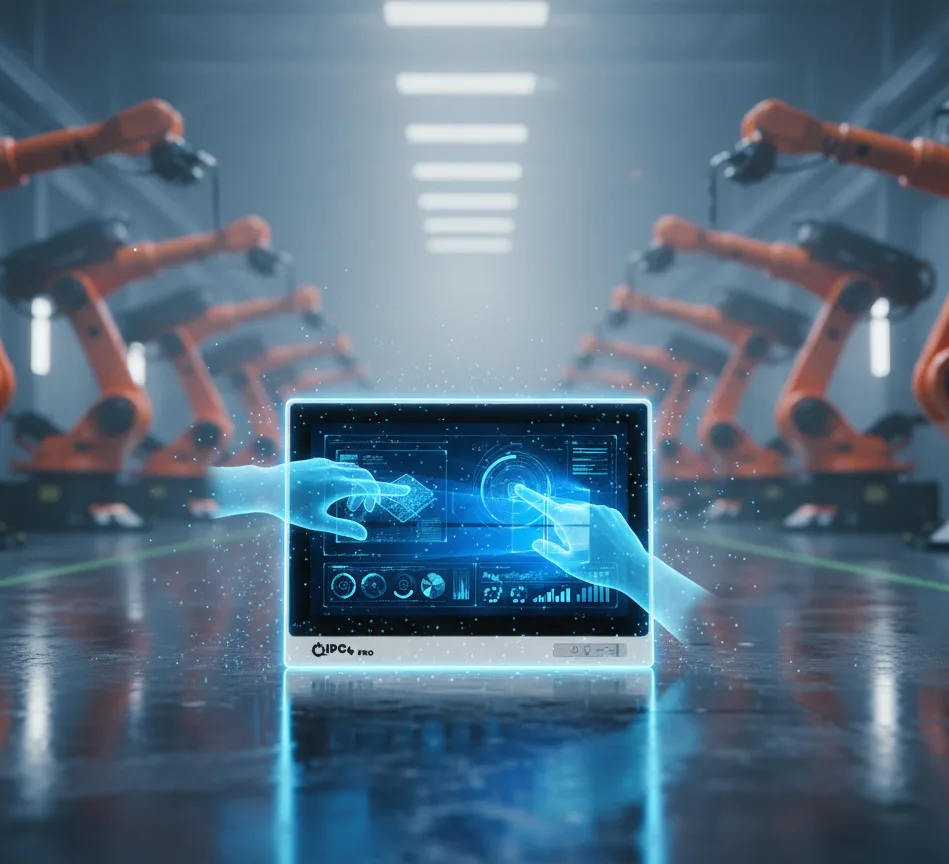
- Universal Touch Detection: Since the operating principle is pressure-based, it does not require conductivity. It can be used with thick work gloves, stylus pens, nails, or any hard object.
- High EMI Resistance: Since signal generation is based on mechanical contact and is not sensitive to delicate capacitive fields, it is naturally much more resistant to environmental electromagnetic interference (EMI) effects.
- Low Cost: Production costs are generally lower compared to PCAP technology.
Limitations
- Tek Dokunmatik (Single-Touch): Due to their design, most resistive screens can only detect a single pressure point at a time.
- Low Optical Quality: Overlapping multiple layers and the air gap can reduce light transmission, resulting in a less transparent or dull image compared to PCAP.
- Surface Durability: The top flexible film layer is more vulnerable to scratches and wear compared to the hard glass surface of PCAP.
3. Logic of Interference Issues in PCAP Screens (EMI)
The high sensitivity, which is the greatest advantage of PCAP technology, also brings the biggest challenge in industrial environments: Electromagnetic Interference (EMI).
The Logic of Sensitivity: Detection at mV Levels
The sensitivity of modern PCAP screens is capable of detecting the natural electrical voltage or capacitive effect of a finger at the millivolt (mV) level. This is similar to the working logic of "active stylus" technology used in some smartphones. These pens can be detected by the screen even if they do not physically touch it, thanks to the very low voltage signal at their tips, and sometimes create a bright "hover" effect on the screen. This is a clear demonstration of the sensitivity of capacitive detection.
The Logic of the Interference Problem: "Ghost Touch"
If a touch screen can accept such a low mV signal from a pen tip as a "touch," it makes it vulnerable to "invisible" signals in industrial environments.
Industrial environments are places where devices such as high-power motors, frequency inverters, welding machines, or high-power contactors operate intensively. These devices continuously emit electromagnetic waves (EMI / EMC) into the environment.
These "invisible" electromagnetic signals induce unwanted small voltages on the sensitive surface of the PCAP screen, just like an active pen or finger. When the control unit cannot distinguish this interference signal from a real user touch, it records this situation as unwanted, erroneous touch detections known as "ghost touch."
Other effects of EMI include reduced sensitivity, delayed response or a general drop in reliability as the controller tries to filter signal from noise.
4. Managing EMI, and Engineering Solutions
Implementing EMI management disciplines is essential for the stable and reliable operation of PCAP screens in industrial environments.
1. Proper Grounding
The most fundamental cause of EMI issues is improper or insufficient grounding. Grounding provides a safe discharge path for parasitic currents that accumulate on the system.
- The machine and screen chassis must be properly and stably grounded.
- Earth resistance should be kept low (typically < 5Ω hedeflenir) ve düzenli olarak ölçülmelidir.
- Methods such as star earthing should be used to stop interference spreading.
2. Shielded Cabling
Cables can act as antennas that collect EMI noise.
- It is essential to use shielded cables for touch screen controllers and power connections to block external electromagnetic interferences.
3. EMI Filters and Ferrite Cores
It is critical to block noise at the source or before it enters the system.
- EMI Filters: Filters integrated into power lines reduce high-frequency electromagnetic interference, ensuring more stable operation of the system.
- Ferrite core: A practical and effective solution. Ferrite cores added to the screen's power cable (near the adapter) dampen high-frequency noise components carried over the cable, preventing interference.
- Common-Mode Chokes: Fitted to the touchscreen's data lines, it suppresses interference.
5. Conclusion and Selection Criteria
The correct selection of touch screen technology is about finding the "most suitable" one for the application, not the "best" one.
PCAP Screens should be preferred in the following situations:
- When targeting modern user interfaces that require multi-touch.
- When high optical quality, clarity, and aesthetic design are priorities.
- Critical Condition: In environments where additional engineering measures such as proper grounding, shielding, and filtering for EMI management can be implemented.
Resistive Screens should be preferred in the following situations:
- In challenging working conditions where the use of thick work gloves is mandatory.
- In dusty, dirty, or humid environments.
- In scenarios where the risk of EMI is very high and managing interference is difficult.
- In projects where cost is a priority and simple touch functions are deemed sufficient.
Result: PCAP technology offers a superior user experience in industrial applications; however, the stable operation of this technology depends on the accurate analysis of environmental factors (especially EMI) and the complete implementation of necessary engineering solutions.